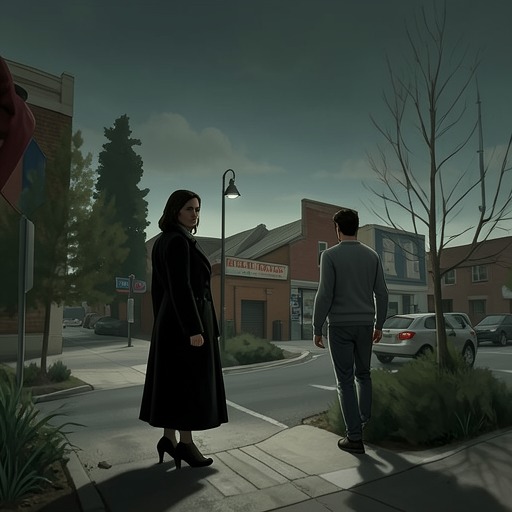
Maggie's Loneliness and Empty Nest Anxiety
Never Kiss a Man in a Christmas JumperMaggie O’Donnell’s loneliness and fear of an empty nest emerge as the familiar structure of her family life begins to change. Her daughter’s growing independence and her father’s expanding social world leave Maggie increasingly alone, while Marco Cavelli’s unexpected companionship reveals how much she has missed adult intimacy. The state is not simply a lack of company: it is a conflict between a safe, carefully maintained life and the possibility of wanting more from it.
Family Life in Transition
Maggie’s daughter, Ellen, studies medicine at Godwin College and still lives at home to save money, but increasingly spends her nights with friends or with Jacob. The distinction matters to Maggie: Ellen remains under her roof, yet is already building a life that does not revolve around her mother. When Ellen explains that Jacob and his family have invited her to spend Christmas in Paris, Maggie’s first reaction is alarm and resistance. She quickly recognizes, however, that Ellen will soon be nineteen, is strong-minded and independent, and should not be denied an experience simply because Maggie fears being left behind. Her thought of the first edition she no longer has to give Ellen also makes the change concrete: an old family ritual cannot simply be repeated as before.
Maggie’s father, Paddy O’Donnell, is also turning outward. He has found a new circle of friends and is considering joining Jim on a last-minute cruise to the Canary Islands, attracted by the company, sunshine, and cheap fare. The prospect carries particular weight because Maggie and her family have always spent Christmas together. She tells Paddy that the trip sounds lovely, but privately understands that another member of her small family unit may be absent. Ellen’s possible journey and Paddy’s proposed cruise are separate decisions, yet together they make the approaching holiday feel like a measure of how quickly the household is changing.
The Quietness of Ordinary Evenings
Before these changes become unavoidable, Maggie’s routine can seem comfortable. She works, watches television, and reads; the evenings are pleasant and safe. But she knows that safety has shaded into a life that feels too small for a thirty-four-year-old. Her comparison of herself to an old maid in a Jane Austen novel turns that concern into dark comedy: she imagines a future of playing the spinet, embroidering domestic slogans, counting grey hairs, and waiting to die. The exaggeration exposes the real fear beneath it—that a life organized around duty and habit may continue without the intimacy or possibility she wants.
The arrival of Marco’s company gives that fear a sharper outline. During one evening together, they talk about their families and past losses: Marco tells her about his life and work in the United States, the death of his father, and the grief Rob Cavelli’s family experienced after the death of Rob’s first wife. Maggie talks about Ellen, Paddy, and her shop. She comes close to discussing more painful parts of her own history, though she does not disclose them then. The conversation itself is significant: she is speaking with someone who is not a relative and who has not known her all her life, and she feels comfortable enough to approach subjects she usually avoids.
Marco’s presence makes the domestic space feel different. Their evenings include conversation, laughter, food, beer, and television, and Maggie realizes that she has been lonely without quite noticing how much. The companionship does not instantly resolve her circumstances; instead, it gives her a brief view of a more shared kind of ordinary life. She anticipates that Marco will leave and that she will have to return to her previous routine, but postpones that worry in order to enjoy the company while it lasts. Her response is especially revealing against the long-standing pattern of her private life: despite having become a mother young, she has never spent an entire night with a man or relaxed into the ordinary closeness of sharing a bed. Her independence has protected her from complications, but it has also left intimacy largely outside her experience.
Christmas Alone
When Paddy tells Maggie that he may spend Christmas on the cruise, she hears the possible loss of a family tradition before she can show how much it hurts. After he leaves, the illuminated houses across the street sharpen the contrast between public festivity and her private expectation. Maggie remembers the imperfect Christmas meals she has prepared—dry turkey, burned sprouts, and over-roasted potatoes—but what mattered was that she, Ellen, and Paddy were together. Their small family unit had made the holiday feel complete even when the food was not.
Now Ellen may be in Paris and Paddy may be away, leaving Maggie to imagine her first Christmas alone, with the tree, a bottle of Baileys, and a microwave dinner for one. Earlier that day she had felt fortunate: she had shared in Isabel and Michael’s happiness, felt satisfied with the wedding dresses at her shop, enjoyed Marco’s company, and received food from her father. The news does not erase those good moments; it changes their emotional balance. She feels deflated and then judges herself for it, believing she ought to be glad that the two people she loves most may have exciting holidays of their own. Her loneliness is therefore joined to guilt: she wants them to have freedom, but fears what their freedom will leave behind.
Love, Fear, and the Limits Maggie Imagines
Marco notices that Maggie has not told Paddy about Ellen’s plans or her own prospect of spending Christmas alone. When he reaches for her hand and asks her to stay and talk, she is visibly withdrawn and unsure. His attention makes it harder for her to hide her sadness, but it also exposes the tension between accepting care and retreating into the self-sufficiency she knows. Later, as their companionship deepens, Maggie recognizes both how much she likes Marco and how much she wants the closeness to continue. She nevertheless tells herself that he will soon be gone and that a renewed intimacy would lead toward an ending she cannot bear.
Her fear is not only about separation. Maggie believes Marco deserves a family like Rob and Leah’s and points to his ease with their son, Luca, as evidence that he would make a natural father. Because she cannot have more children, she assumes that continuing the relationship would deprive Marco of a future he ought to have. When she confesses her love and infertility to Leah, she says she needs to end things for both their sakes, while also admitting that she does not know how to do it. Leah challenges the assumption at the center of Maggie’s reasoning: whether Marco wants children or considers them essential is for him to decide, not for Maggie to settle on his behalf.
Maggie’s later regret over leaving without explanation shows how fear turns into action. She recognizes that she should have stayed to talk rather than disappearing, and calls her choice selfish and cowardly even while acknowledging that she had thought she was protecting Marco. His answer presses her to reconsider the world of objections she has built around the relationship. He does not deny that infertility will make their future difficult, but insists that it does not define all that they could be together. Maggie does not arrive at certainty in this moment; she begins to feel a small break in the defenses she has used to keep possibility at a distance.
Narrative Significance
Maggie’s loneliness is shaped by a transition rather than a single abandonment. Ellen’s growing independence and Paddy’s possible holiday plans unsettle the family pattern that has organized Maggie’s Christmases, while Marco’s attention reveals the emotional cost of the quiet life she has treated as sufficient. The holiday setting brings these changes together: a season associated with reunion makes the prospect of being alone newly visible.
The deeper conflict lies in Maggie’s attempt to turn care into self-denial. She loves Marco, but decides that his presumed wish for a conventional family must outweigh his right to choose a life with her. Her fear of the empty nest thus connects to a larger fear of becoming unwanted or insufficient once her role as a mother no longer fills every space. By voicing her love and infertility to Leah, and by beginning to hear Marco’s response, Maggie moves from silently managing loss toward acknowledging what she wants. The evidence leaves that change in progress rather than presenting loneliness as already overcome.